
Five Ways a Stone Can Turn Pink
Rose quartz, pink Himalayan quartz, lavender calcite, pink garnet, and stilbite can all read pink, but they get there by different chemistry. Five mechanisms, five stones, and what each one tells you about handling and buying.
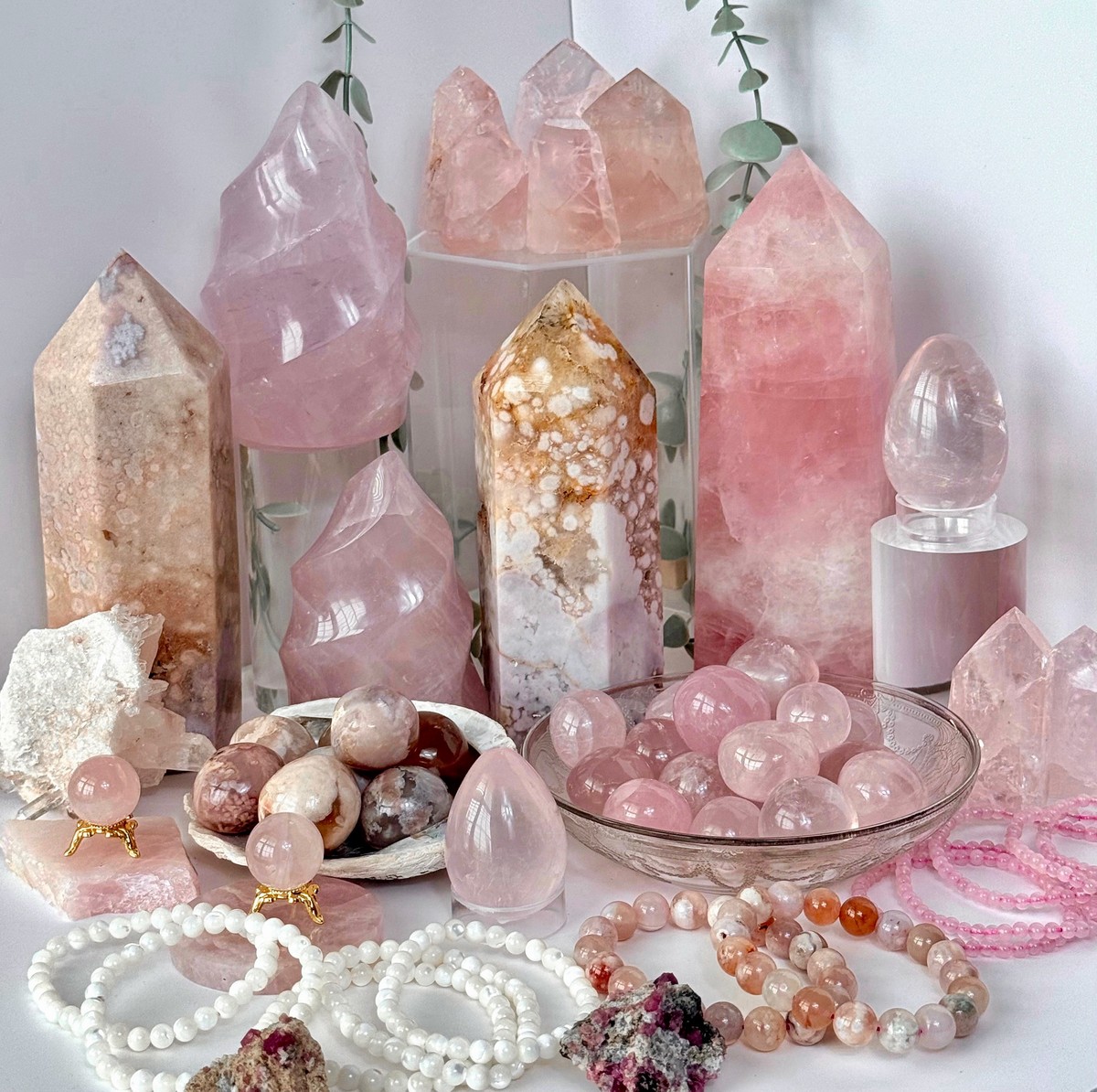
This website drop contains blush colored spheres, dusty rose towers, stillbite the color of the inside of seashell… It may read as a single color palette, but it actually isn’t.
These crystals arrived at that color by at least five unrelated routes. Two pieces sitting side by side may have nothing chemically in common beyond the fact that both ended up pink. One is pink because of microscopic fibers. Another because of a trace of iron. Another because of manganese sitting where calcium should be. The color is the coincidence, not the connection.
Here's what's actually happening in each.
Rose quartz has fibers, not pigment
Rose quartz is the odd one, and the most interesting.
Most colored minerals get their color from something dissolved into the crystal lattice. It’s an atom of the wrong element sitting in a spot where it changes how light passes through. Rose quartz doesn't work that way. Its pink comes from vast numbers of microscopic fibrous inclusions distributed through the quartz as it grew, far too fine to see individually, scattering light in a way that reads as blush.
That's why rose quartz is rarely transparent the way amethyst or citrine can be. The cloudiness and the color are the same phenomenon. You can't have one without the other.
And it explains something that seems unrelated: the star. Those same fibers, where they've grown along the three structural directions quartz's trigonal symmetry allows, reflect light back as bands. Three sets of fibers, sixty degrees apart, three bands crossing at a point… a six-rayed star. The star and the color share an origin. Star rose quartz isn't a different material with a bonus feature. It’s rose quartz where the fibers happen to be dense enough and well-aligned enough to do both jobs at once.
Worth knowing that the star only assembles under a single direct light source held roughly behind your line of sight. In an evenly lit room the same stone reads glowing pink and the star has nowhere to form. That's the lighting, not the stone.
Pink Himalayan quartz has traces of iron
The pink Himalayan clusters work on a completely different principle, and the giveaway is that they're clear.
These are water-clear quartz points with a pink cast. That difference matters. Their transparency means the color is coming from something in or on the crystal lattice, not from a cloud of inclusions scattering light.
For pink and red quartz from the Himalayan deposits, the color is generally attributed to trace iron. It’s often a fine coating of iron oxide picked up during or after growth, sometimes as inclusions of iron minerals within the crystal. On some specimens you can see it directly. A dusting of color concentrated on certain faces or along fractures rather than distributed evenly through the whole crystal.
Worth being honest here. Color causes in quartz are a genuinely tangled subject, and different specimens from different pockets can owe their tint to different things. What's reliable is the structural observation. A clear body with a pink cast means the color is lattice or surface, not fiber scattered. That's a distinction you can make by eye, and it separates these clusters from every piece of rose quartz in the drop.
Lavender calcite happens when manganese is in the wrong seat
Calcite is calcium carbonate, and pure calcite is colorless or white. Color arrives when something takes calcium's place in the structure.
Manganese is the usual culprit for pink. Substituted into calcium sites, it produces the soft pinks and lavenders that mangano calcite and lavender calcite are known for. Manganese bearing calcite is frequently fluorescent: put it under a UV lamp and it can glow a pink or red, far more saturated than its daylight color.
Not every piece fluoresces, and intensity varies with how much manganese is present and what else is in there alongside it. But it's worth testing. A calcite that looks quietly lavender on a shelf can be the most dramatic thing in a collection under a blacklight.
Calcite is also soft. It’s only a 3 on the Mohs scans and is easily scratched by metal or harder stones sharing a bowl with it. Store it where it isn't being knocked against quartz.
Pink grossular garnet happens due to chromium
Grossular is a calcium aluminum garnet, and it spans an enormous color range depending on what trace elements find their way in. Green grossular is tsavorite. Orange or brown is hessonite. The pink and rose varieties generally owe their color to trace chromium, sometimes with manganese contributing.
What makes the drop's grossular pieces worth a second look is the matrix. These aren't cut stones, they're garnet crystals still sitting in the rock they formed in. That context is genuinely informative… You can see the host rock and the relationship between crystal and matrix.
Garnet is also hard. It’s a 6.5 to 7.5 on the Mohs scale depending on species. You won’t need the careful handling that calcite and selenite do.
Stilbite is peach and is a zeolite
Stilbite is a zeolite, a family of minerals that form in gas cavities in volcanic rock. They typically form alongside apophyllite, heulandite, and scolecite. Most of the world's specimen material comes from the basalt quarries of India.
Its characteristic peach and salmon tones come from trace iron. stillbite is distinctive due to its blade like structure and pearly luster rather than cubic formations like apophyllite. The color tends to read warm rather than cool, which is why stilbite looks peach next to rose quartz's blush even when the two are similar in intensity.
Zeolites are soft. They are usually a 3.5 to 4 on the Mohs scale. Stilbite's bladed structure means the edges vulnerable. Please ensure you’re handling them by their matrix when at all possible.
Why any of this matters
Because it changes what you're looking at.
A shelf of pink stones are beautiful. A shelf where you know the rose quartz is pink because of its fibers, the Himalayan quartz because of iron, the calcite because of manganese sitting where calcium would usually be… That’s a handful of separate stories about how the earth arrives at the same answer by different routes.
It also makes you a better buyer. Knowing calcite is a 3 and garnet is a 7 tells you which one to keep out of the bowl with the tumbles.