
Crystals for the Harvest Moon
Carnelian agate, sea jasper, polychrome jasper, petrified wood, Brazilian agate and Sahara druzy: the warm stones of harvest season and what each is for.
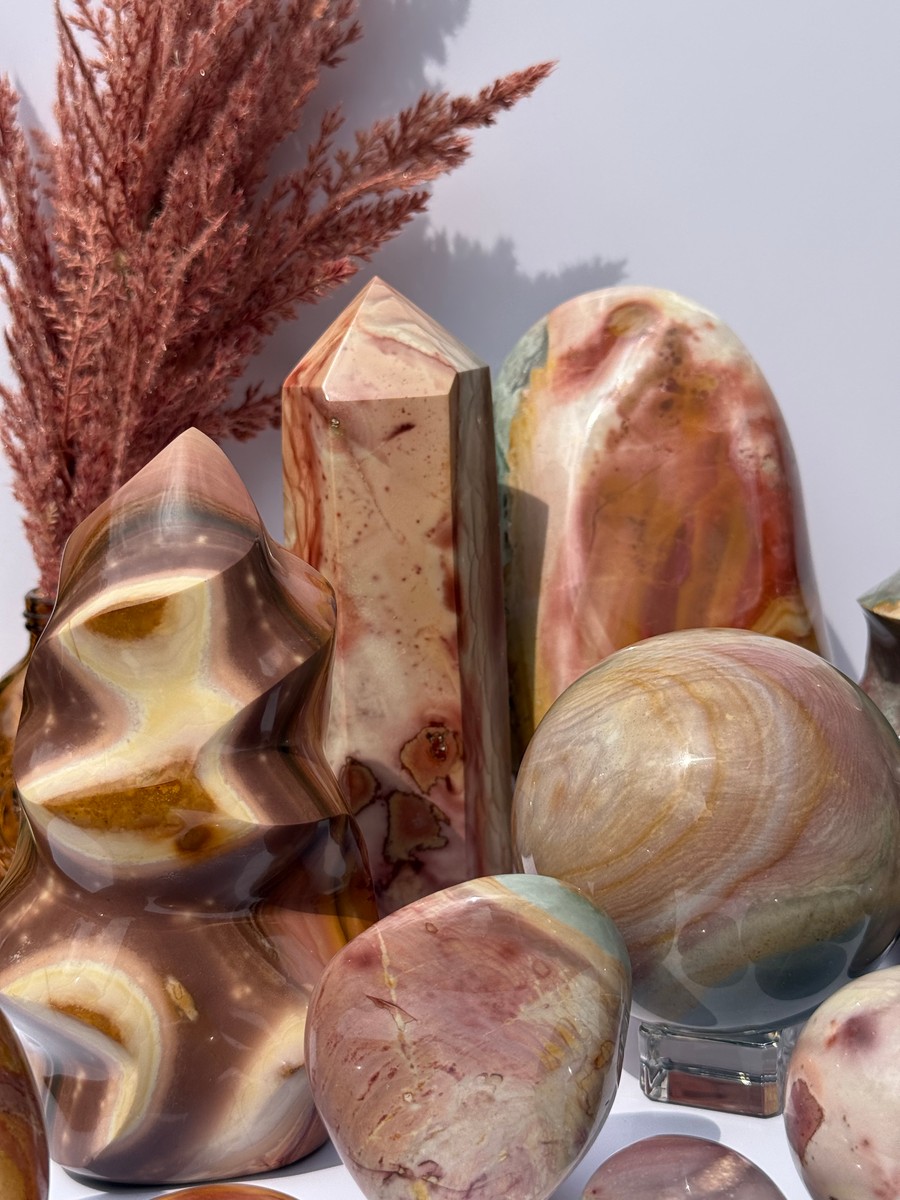
The Harvest Moon is the full moon nearest the September equinox. During the Harvest Moon, the moon rises low and looks orange as the daylight fades.
Our Harvest Moon Drop opens on the evening of September 26, 2026, the day this year's Harvest Moon turns full. We built this drop around stones that carry that color and that color. We focused on carnelian, sea jasper, polychrome jasper, petrified wood, Brazilian agates and druzy quartz from the Sahara. This guide is a short introduction to each one. A little bit of education about where they come from with a little of the science behind their creation and their intentions.
Carnelian agate and the color of autumn leaves
Carnelian is technically a chalcedony and gets its orange and red coloring from traces of iron. When the color settles into bands, it becomes carnelian agate.
Carnelian is the stone of warmth, courage and momentum. It's the one people reach for when they want a little extra nerve for a fresh start, or the push to begin working on the things they keep putting off.
Carnelian is a 6.5 to 7 on the Mohs scale of hardness. It’s scratch resistant so it is able to take a high polish. Because of that, it suits every shape it comes in and is a great crystal to carry around with you in your pocket.
Sea jasper from the coast of Madagascar
Sea jasper comes from the northwest coast of Madagascar. It formation began long ago as volcanic ash and lava along the coast. Over the ages, silica-rich water soaked through rock and turned it to stone. During that process minerals gathered into rings and orbs which formed the famous colors and patterns sea jasper is so known for.
Jasper of every kind is a steadying stone. Sea jasper in particular has intentions of calm and patience. We find that surrounding yourself with sea jasper can help create the feeling of a super long exhale. People keep it where they unwind for that reason.
Polychrome jasper and why it looks like a desert landscape
Polychrome jasper comes only from Madagascar, where it was discovered in the 2000s. Like most jasper it is mostly silica, grained so finely and packed with so many other minerals that light can't pass through. The colors were formed by those mineral inclusions in bands and swirls that make each piece look like a desert landscape.
Its associations fit with its vibe. Polychrome jasper is a stone of grounding and creativity. We like to keep our polychrome in places we are looking for that extra spark of creative inspiration.
How petrified wood forms
Petrified wood is a tree that turned to stone one cell at a time. It’s formed when wood is buried in wet sediment for millions of years. The wood soaks up mineral rich water until silica replaces its structure. The woods growth rings survive the silica exchange, which is why it still maintains its wood grain.
Petrified wood is fittingly the stone of patience. It is associated with steadiness and the calm that comes from knowing that the best things in life take time. People keep it where they do work that unfolds slowly. We like to keep ours close by when we are studying or writing.
Druzy quartz from the Sahara desert
This stone comes from the edge of the Sahara in southern Morocco. Our collection in particular came from the manganese country south of the High Atlas near Ouarzazate. It’s the town Moroccans call the door of the desert. This quartz started forming 100 million years ago when the region lay under a shallow sea. The sea left behind beds of dolomite, and much later water worked through that rock and hollowed out caves that lined them with two minerals. Black manganese oxide and goethite. Silica rich water came last and frosted everything with a crust of tiny quartz crystals. That crust is the druzy, and it is why these pieces sparkle like sugar.
Druzy quartz is a stone of clarity and calm. The manganese and goethite beneath it are grounding. Together they make a stone perfect for stepping back and seeing the bigger picture. We like to keep ours close by when we’re navigating big decisions or need a moment to pause and reset.
Brazilian agates and what causes their banding
Most agates start as a gas bubble in cooling lava. Around 130 million years ago enormous lava flows spread across what is now southern Brazil. As they cooled, they trapped countless pockets of gas. Over the years, silica-rich water seeped into those pockets and lined them layer by layer. Every change in the water left a band.
Brazilian Agate Slices are made to be backlit. We like to set ours up in a window so the bands light up like stained glass.
Agate is a stone of balance and composure. We like to keep it close by when we need a reminder to slow down and stay grounded.
Sphere, tower, flame, freeform or bracelet?
Questions people ask
Should I charge my crystals under the Harvest Moon?
Many people set their stones out on the night of the full moon to clear and reset them. The Harvest Moon rises early and bright which means it’s one of the best nights of the year to do it. Moonlight is gentle on color, so it is safe for everything in this guide. Set your pieces out after sunset, bring them in before the dew settles, and enjoy the excuse to step outside on a bright night.
How do I care for these stones?
All six stones mentioned in this guide are hard enough to live on a shelf without issue. Dust with a soft cloth. A quick rinse in plain water is fine for polished carnelian, agate, jasper and petrified wood. Skip long soaks with salt and harsh cleaners. For the druzy pieces, handle them gently. We like to use compressed air to clean these.
When is the Harvest Moon each year?
It's the full moon closest to the September equinox, so it falls between early September and early October. In 2026 it turns full on September 26. When October's full moon sits closer to the equinox, it takes the name instead, as it did in 2025 and will again in 2028.